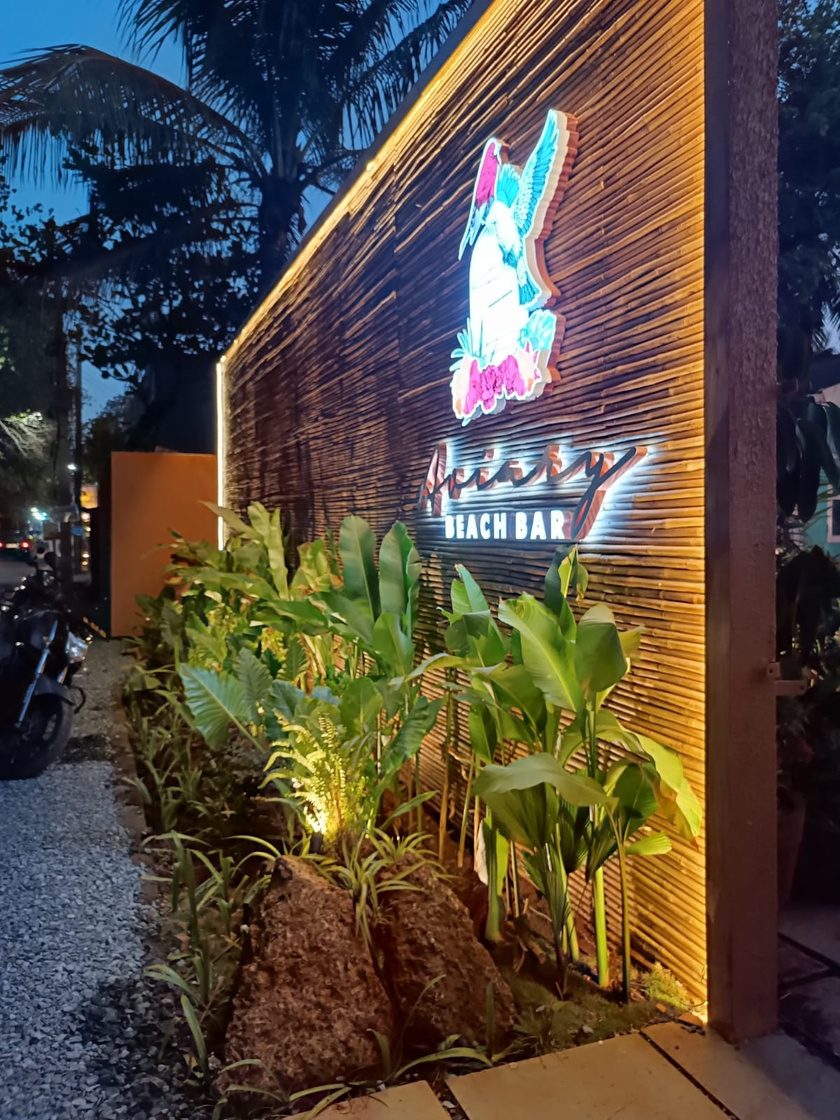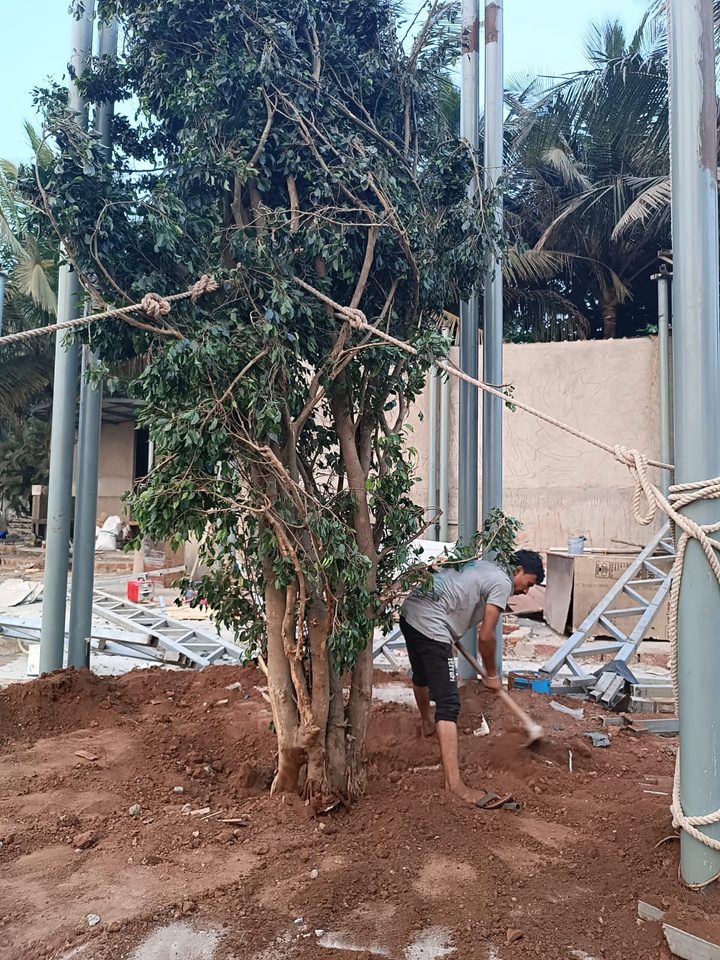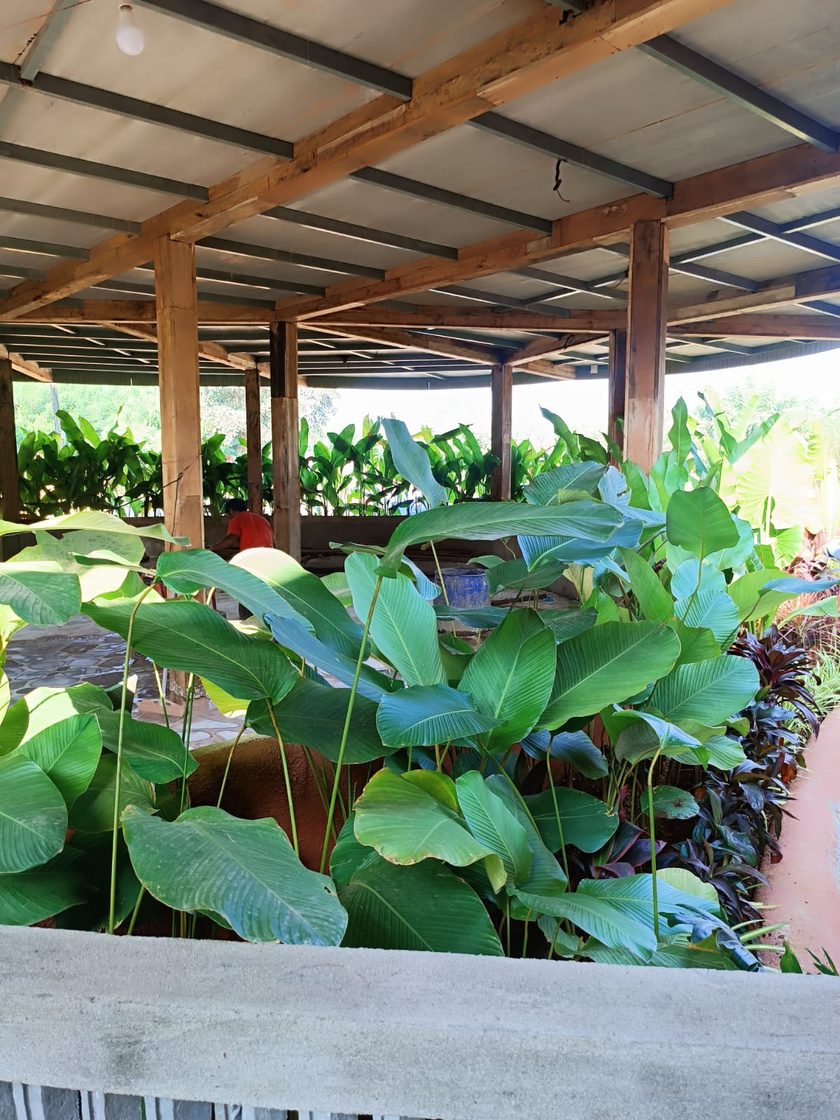
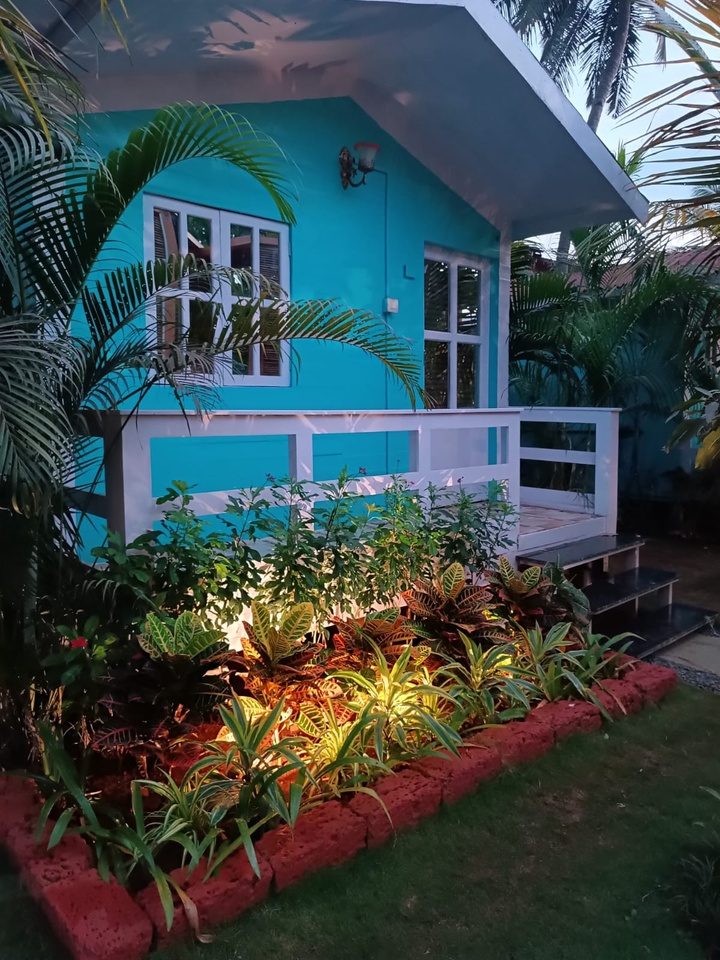
We have planted several venues in Goa that almost nobody sees in daylight. Goya at Vagator, Aviary, Cohin. The staff see the garden at four in the afternoon. Every paying guest sees it between eight at night and two in the morning, lit.
That single fact changes most of the decisions.
Colour stops mattering. Form starts.
Under artificial light, flower colour largely disappears — warm light flattens pinks and reds, and most garden lighting is warm. A bougainvillea that is the whole point of a bed in daylight is a dark mass at night.
What reads after dark is shape and texture: the silhouette of a traveller’s palm, the ribbed shadow a heliconia throws on a wall, the outline of a frond against a lit surface. So the planting is chosen for structure and leaf, and colour is treated as a daytime bonus rather than the brief.
Light the surfaces, not the plants
The instinct is to put a spotlight on each specimen. It produces a row of bright plants floating in blackness and it looks like a car park.
What works better is lighting the things behind and beneath the planting — a laterite wall, a stone path, the water in a fountain court — and letting the planting read as silhouette and shadow against it. At Goya the rock and fountain court in front of the building is lit as a surface; the planting sits in and around it and gains its shape from that.
It is also cheaper, because you are lighting a handful of planes rather than forty individual plants.
The layout is decided by people, not by design
A venue garden has a crowd moving through it at night, in the dark, holding drinks. That means:
- Nothing sharp, spiky or toxic within reach of a walkway. Agave and similar are beautiful and entirely wrong beside a queue.
- Beds raised or clearly edged, so the boundary between path and planting is readable at ankle height in low light. The terraced, hard-edged beds we build against laterite do this as a by-product.
- Planting dense enough to survive being leaned on, because it will be. Sparse beds with exposed soil become bare soil by the end of a season.
- Nothing that drops heavily onto a walking surface. Frangipani is a lovely tree and it drops flowers onto a wet path.
What it costs you
The lighting is usually the largest single line, and it is the one that gets cut first when a budget tightens. Cutting it is a false economy on a night venue: you have then paid for a garden that nobody will ever see.
If the budget is tight, the better trade is fewer, larger plants and proper lighting, rather than a full planting scheme lit by whatever was already on the building.
What this does not cover
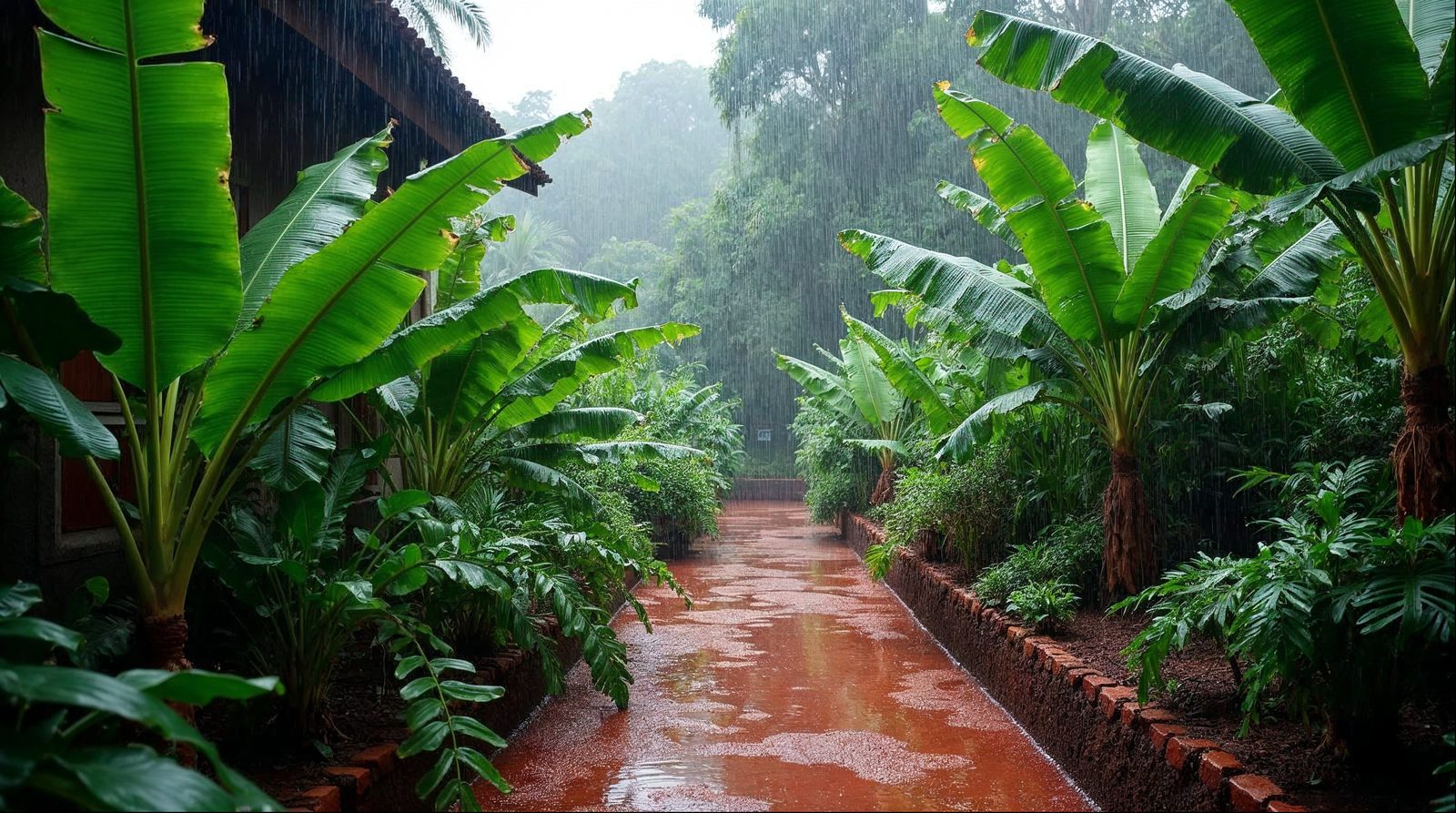
Everything above is about how the garden reads. It says nothing about how it survives — a venue garden takes foot traffic, spilled drinks, salt air on the coast, and four months of monsoon, and the plant list still has to answer all of that first. Form is the second filter, not the first.